Every strong marketing strategy starts with understanding your buyer’s path and the lead nurturing journey is the roadmap that ensures no opportunity slips through the cracks.
The lead nurturing journey isn’t just about following leads through the funnel but about guiding them with relevance, empathy, and timing at every step. When mapped correctly, it creates an experience so seamless that your brand feels like a trusted advisor instead of a persistent seller.
Let’s explore how to design, automate, and optimize your lead nurturing journey from awareness to advocacy, and why every stage matters more than you think.
Why Mapping the Lead Nurturing Journey Matters?
Without a clear journey map, leads often get lost between marketing messages and sales follow-ups. That’s why mapping the lead nurturing journey is essential, it helps you visualize every touchpoint that turns awareness into trust.
“If you don’t define your lead journey, your leads will define it for you and that’s a risk you can’t afford.”
A mapped journey provides:
- Clarity: You know exactly where each lead stands.
- Consistency: Every message supports the next step.
- Conversion: Each stage naturally leads to the next.
Mapping isn’t a marketing luxury, it’s a strategic necessity.
Understanding the Lead Nurturing Funnel
The lead nurturing journey is essentially a humanized version of the marketing funnel. Instead of focusing solely on conversions, it focuses on building relationships.
The Four Core Stages of the Lead Nurturing Journey
1. Awareness: The Discovery Phase
Leads at this stage are problem-aware but not solution-aware. They’re searching, comparing, and learning.
Your goal: Just educate, not sell.
Provide helpful resources like blogs, infographics, or short guides that clarify their challenge and position your brand as a credible source.
Examples:
- Blog: “5 Hidden Leaks in Your Marketing Funnel”
- Downloadable: “Beginner’s Guide to Lead Nurturing”
2. Consideration: The Evaluation Phase
Leads now understand the problem and are exploring solutions. They start comparing you against competitors.
Your goal: Build trust and preference.
Use case studies, expert insights, webinars, or testimonials to highlight your credibility and impact.
“During the consideration phase, confidence is your strongest conversion tool.”
3. Decision: The Conversion Phase
Leads are close to a purchase decision. They need assurance that your solution fits their unique situation.
Your goal: Reduce friction and increase confidence.
Offer demos, audits, or free consultations that remove doubt and reinforce value.
Example: “Get a free 15-minute strategy call to identify your best next move.”
4. Advocacy: The Loyalty Phase
After conversion, most brands stop communicating and that’s where opportunities die.
Your goal: Delight and retain.
Nurture your new customers through personalized onboarding, appreciation campaigns, and referral programs. Loyal clients amplify your message more powerfully than ads ever can.
“The real ROI of lead nurturing begins after the sale.”
How to Map Your Lead Nurturing Journey Step-by-Step
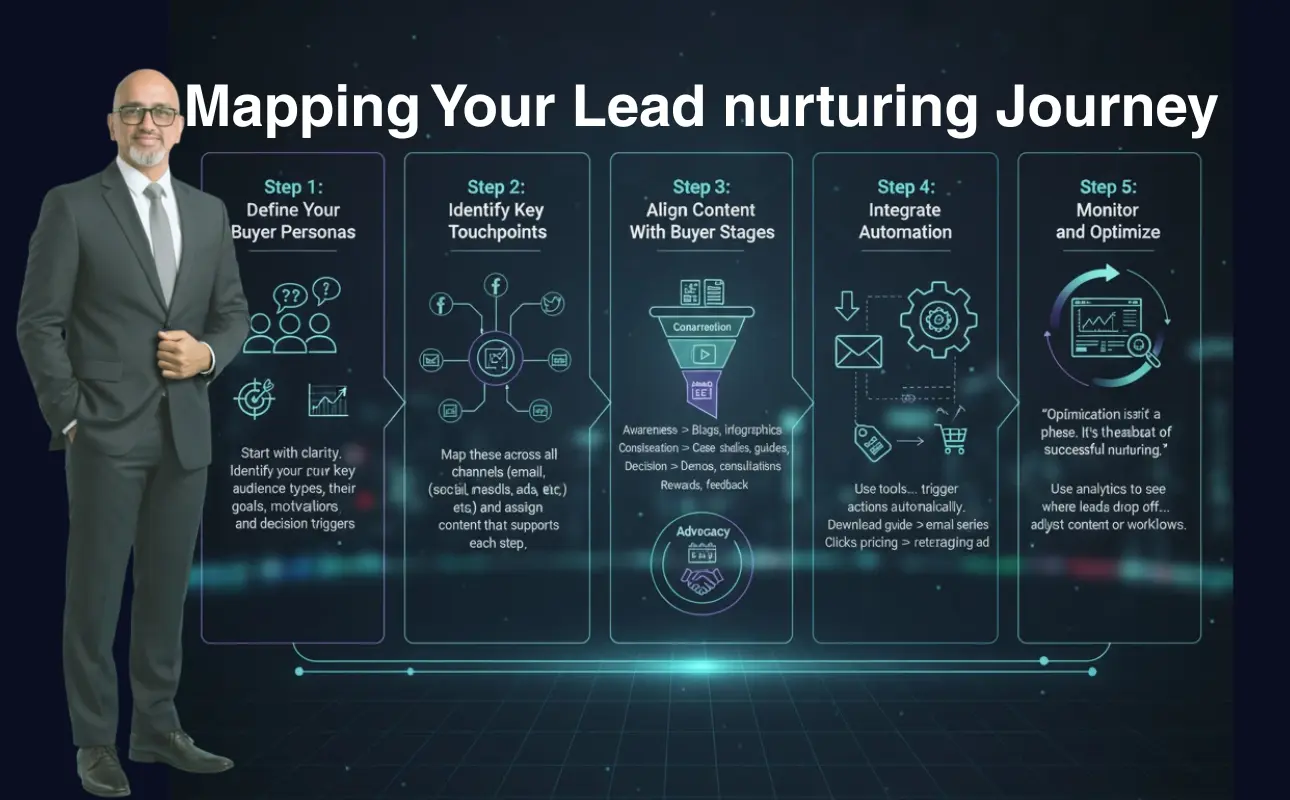
Mapping your lead nurturing journey involves connecting psychology, data, and automation. Here’s a proven 5-step approach:
Step 1: Define Your Buyer Personas
Start with clarity. Identify your key audience types, their pain points, goals, motivations, and decision triggers. This ensures that your content, tone, and timing align with real human behavior, not assumptions.
Step 2: Identify Key Touchpoints
Every interaction, from your first blog visit to your last email, is a potential nurturing moment. Map these across all channels (email, social media, ads, chat, etc.) and assign content that supports each step.
Step 3: Align Content With Buyer Stages
Use a content funnel approach:
- Awareness → Educational blogs, infographics
- Consideration → Case studies, guides, explainer videos
- Decision → Demos, free consultations
- Advocacy → Loyalty rewards, feedback loops
Step 4: Integrate Automation
Once your journey is mapped, use tools like GoHighLevel or HubSpot to trigger actions automatically.
For example:
- When a lead downloads a guide → trigger an educational email series.
- When a lead clicks a pricing page → trigger a retargeting ad or sales call follow-up.
Step 5: Monitor and Optimize
A lead nurturing journey is never static. Use analytics to see where leads drop off or stagnate and adjust your content or workflows accordingly.
“Optimization isn’t a phase. It’s the heartbeat of successful nurturing.”
The Role of Emotional Momentum in the Journey
Every lead nurturing journey has an emotional rhythm, curiosity, trust, comfort, and advocacy. If one stage fails emotionally, progress halts.
To maintain emotional flow:
- Match tone with lead intent (educate early, empathize later).
- Keep communication consistent but never overwhelming.
- Use storytelling to sustain engagement between stages.
Emotion keeps the journey alive; data keeps it measurable.
Visualizing the Lead Nurturing Journey
Here’s a simplified model to visualize your lead nurturing journey:
| Stage | Buyer Emotion | Brand Role | Ideal Content | Automation Trigger |
|---|---|---|---|---|
| Awareness | Curiosity | Educator | Blog, Infographic | New subscriber signup |
| Consideration | Confidence | Expert | Case Study, Webinar | High engagement score |
| Decision | Clarity | Advisor | Demo, Consultation | Pricing page visit |
| Advocacy | Gratitude | Partner | Review Request, Loyalty Email | Purchase complete |
This simple grid helps you align human emotions with automation workflows, the sweet spot of modern marketing.
Mistakes to Avoid in the Lead Nurturing Journey
Even a well-mapped journey can fail if execution misses the mark. Watch out for these pitfalls:
- Treating All Leads the Same: One-size-fits-all messaging breaks trust.
- Skipping Post-Purchase Nurturing: Retention is as important as acquisition.
- Data Blindness: If you don’t track journey metrics, you can’t improve them.
- Inconsistent Messaging: Conflicting tones between channels confuse prospects.
Consistency and empathy should guide every touchpoint, not just automation logic.
How AI Enhances the Lead Nurturing Journey
AI is transforming how marketers understand and manage journeys.
With AI-driven insights, you can:
- Predict where leads are likely to drop off.
- Suggest the best next message based on engagement.
- Score leads automatically using behavioral intent.
- Create adaptive workflows that change as leads evolve.
“AI makes your nurturing journey responsive, but empathy keeps it relevant.”
By blending AI with human strategy, you make every touchpoint feel intentional, timely, and personal.
Measuring the Success of Your Lead Nurturing Journey
Track what matters and not just what’s easy.
Key performance metrics for your lead nurturing journey include:
- Engagement Rate: Indicates relevance and timing accuracy.
- Conversion Velocity: Measures how fast leads progress through stages.
- Pipeline Value: Reflects nurturing effectiveness on revenue growth.
- Customer Retention Rate: Evaluates long-term impact of post-purchase nurturing.
Continuous measurement ensures your journey stays both customer-focused and ROI-driven.
Bringing It All Together
The lead nurturing journey is the bridge between brand awareness and brand loyalty. When you map it with empathy, support it with automation, and fuel it with data, every lead feels guided — not sold to.
Ultimately, nurturing is about delivering meaning at every stage of the funnel.
“Leads don’t fall through the cracks when every step feels like progress.”