
A meta ad creative testing system is the difference between scalable growth and expensive guessing. Most advertisers believe they are testing creatives, but what they are really doing is launching random ads and hoping something works.
They launch multiple ads.
Wait a few days.
Kill most of them.
Scale one or two.
Repeat.
When results drop, they blame fatigue, the algorithm, or competition.
What’s missing is not effort.
It’s structure.
Random Testing Is Not Testing
Testing means learning something specific.
Most campaigns don’t.
They change:
- Copy
- Visuals
- Formats
- Audiences
- Offers
All at once.
Then they look at the numbers and pretend conclusions exist.
They don’t.
Without control, there is no learning.
Without learning, there is no scale.
What looks like activity is often just noise.
Why Most Meta Ad Creative Testing Systems Fail
Almost every weak testing process fails for the same reasons.
No Hypothesis
People launch ads without a belief.
They don’t ask:
What do I think will work, and why?
Without a hypothesis, data is meaningless.
Too Many Variables
When everything changes, nothing is measurable.
If you change:
Message + visual + format + audience
you’ve tested nothing.
You’ve only confused yourself.
Killing Too Early
Early data is unstable.
Small sample sizes create fake winners and fake losers.
Panic decisions destroy long-term learning.
No Documentation
Most advertisers repeat mistakes.
They don’t track:
- What was tested
- Why it was tested
- What was learned
Experience gets wasted instead of compounded.
Without a structured meta ad creative testing system, most advertisers remain stuck in trial and error mode.
Why Creative Testing Must Be Treated as a System
Most teams treat ads like files.
Upload. Run. Replace.
High-performing teams treat creative like components.
Every ad is built from four elements:
Message
Format
Context
Proof
Each element can be tested independently.
This is what makes scale possible.
You are not creating “ads.”
You are building combinations.
The Meta Ad Creative Testing System Framework
Here is a practical structure that works across industries.
Phase 1: Message Testing
Start with meaning.
Test:
- Core pain points
- Desired outcomes
- Emotional triggers
- Objections
Goal:
Find what makes people care.
If the message fails, nothing else matters.
Phase 2: Format Testing
Once message works, test delivery.
Compare:
- Video vs static
- UGC vs studio
- Talking head vs demo
- Short vs long
Goal:
Find how attention behaves.
Same message. Different containers.
Phase 3: Proof Testing
Attention doesn’t equal trust.
Test:
- Testimonials
- Screenshots
- Case results
- Authority cues
Goal:
Remove hesitation.
This is where many campaigns stall.
Phase 4: Scaling Validation
Before scaling, verify stability.
Test:
- Variations of winners
- New audiences
- Fatigue resistance
Goal:
Build durability, not spikes.
How to Budget for Creative Testing and Learning
Most advertisers treat testing as waste.
That’s backwards.
Testing is research and development.
Serious brands allocate:
- Exploration budget (learning)
- Exploitation budget (scaling)
Without exploration, performance decays.
Without exploitation, learning is wasted.
Balance creates leverage.
How to Read Meta Ad Creative Performance Data
Many advertisers read dashboards incorrectly.
They optimize for visible numbers, not meaningful ones.
Common traps:
High CTR with low sales
High ROAS with low volume
Low CPM with weak intent
High engagement with no buyers
These are illusions.
A better signal chain:
Hook → Hold → Click → Convert → Repeat
If any link breaks, scale collapses.
Building a Repeatable Creative Testing Workflow
Winning teams follow processes, not moods.
A simple workflow:
Idea
Hypothesis
Production
Launch
Observe
Document
Iterate
Every test feeds the next.
No chaos.
No emotional resets.
No guesswork.
Systems create confidence.
When to Scale and When to Kill Ad Creatives
Discipline matters more than optimism.
Scale When:
- Results stabilize
- Margins hold
- Backend performs
- Learning is clear
Kill When:
- No insights emerge
- Trends stay negative
- Structural flaws appear
Don’t scale hope.
Don’t kill patience.
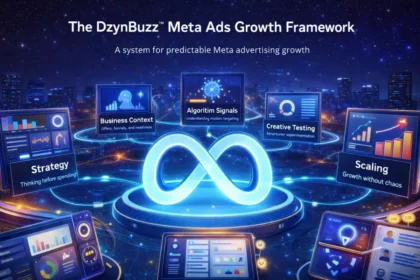
A reliable meta ad creative testing system turns random campaigns into predictable growth engines. The DzynBuzz Meta Ads Growth Framework series isn’t for people looking for quick wins or recycled tactics.
It’s for founders and marketers who want fewer ads, better thinking, and sustainable growth.
From Campaigns to Scalable Testing Systems
Random ads fail.
Systems scale.
Meta does not reward hustle.
It rewards structure.
The advertisers who win long-term think like engineers, not gamblers.
They don’t chase winning ads.
They build environments where winning becomes normal.
In the next article, we’ll examine how funnels, forms, and conversations determine whether Meta Ads produce leads or revenue, because traffic without architecture is just expensive noise.