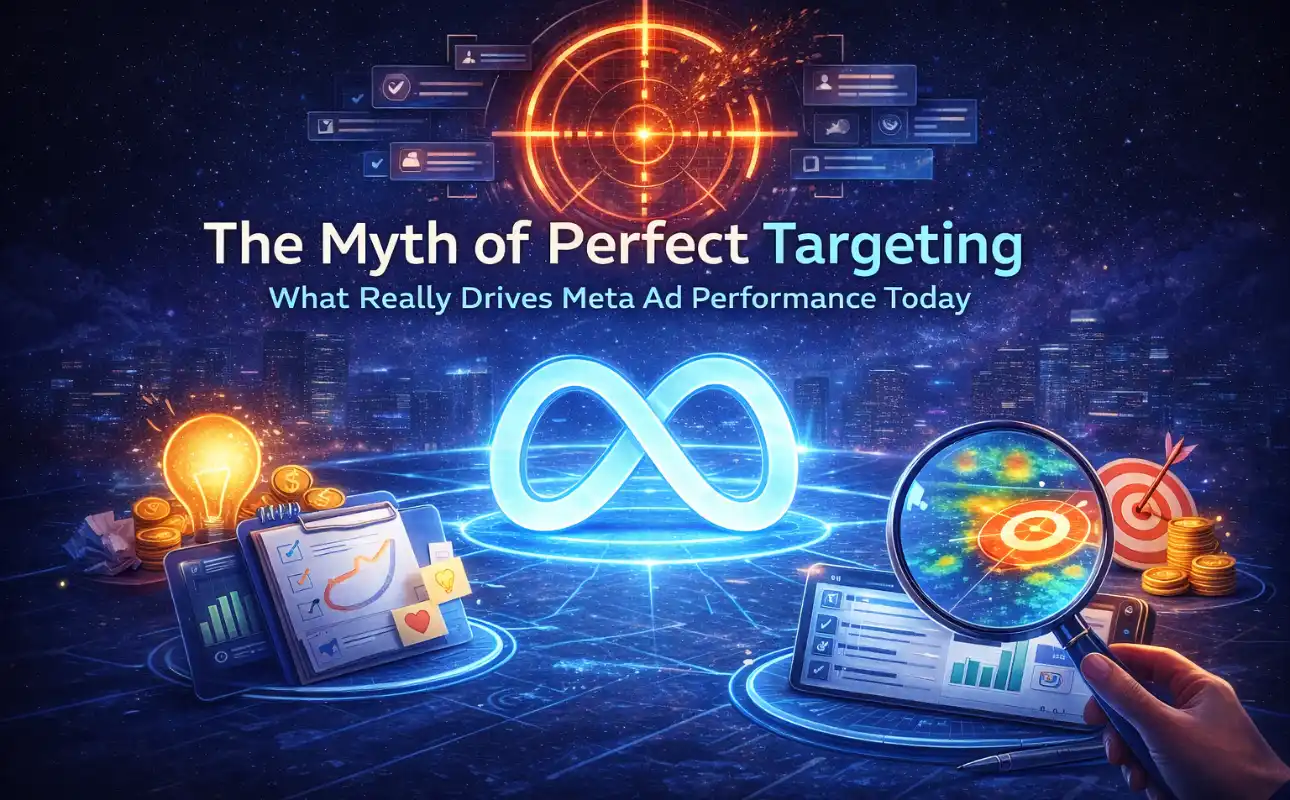
The meta ad targeting myth has shaped how advertisers think for years. Many still believe that finding the perfect audience is the secret to consistent Meta ad performance.
So they chase interests.
Layer behaviours.
Build lookalikes.
Create micro-audiences.
They believe performance lives inside targeting settings.
That era is over.
Today, most campaigns fail not because of poor targeting, but because advertisers misunderstand how Meta actually finds buyers.
Why the Meta Ad Targeting Myth Still Exists
Open any beginner course and you’ll still see it.
Long modules on:
- Interests
- Demographics
- Detailed targeting hacks
- Audience stacking
The underlying promise is simple:
Crack the audience, and you crack the system.
But here’s the reality.
Two advertisers can target the same audience.
One scales.
One burns money.
The difference is not targeting. It’s signal quality.
This is why the meta ad targeting myth continues to mislead advertisers who focus on settings instead of systems.
How Meta Finds Buyers Beyond Traditional Targeting
Meta no longer relies primarily on who you think your customer is.
It relies on how people behave.
The system continuously observes:
- Who stops scrolling
- Who watches
- Who clicks
- Who engages
- Who converts
- Who returns
Every interaction becomes training data.
Your targeting inputs are starting points, not control systems.
The real optimization happens after launch.
This is why small, well-designed campaigns often outperform “perfectly targeted” ones.
They generate cleaner signals.
Why Over-Targeting Hurts Meta Ad Performance
Many advertisers narrow too fast.
They think:
Smaller audience = higher relevance.
What they get:
- Higher CPMs
- Slower learning
- Faster fatigue
- Distorted data
When audiences are too small, Meta struggles to explore.
It keeps recycling the same users.
Performance drops.
Advertisers panic.
They reset.
The cycle repeats.
This isn’t optimization.
It’s self-sabotage.
How Creative Replaces Targeting Signals
This is the shift most people still don’t understand.
Your creative now does most of the targeting work.
Every ad tells Meta:
- Who should see this
- Who ignores it
- Who reacts
- Who buys
Bad creative sends bad data.
Good creative builds intelligent campaigns.
Creative is not decoration.
It is information.
It communicates:
- Problem awareness
- Emotional relevance
- Timing
- Trust level
- Purchase intent
When your creative is vague, the algorithm guesses.
When it is clear, the system learns.
From Targeting Hacks to Testing Systems
Modern advertisers don’t “find audiences.”
They build learning systems.
Old approach:
Find audience → Push ads → Hope
New approach:
Test message → Observe signals → Refine → Scale
This means:
You test:
- Angles
- Hooks
- Pain points
- Proof types
- Offers
Not just visuals.
Each test teaches Meta who responds.
Over time, the system builds precision you could never manually design.
This is how scaling actually happens now.
What High-Performance Meta Advertisers Do Differently
The difference between average and elite advertisers is structural.
Old School Thinking
- 15 ad sets
- Dozens of interests
- Tiny audiences
- Constant resets
Modern Thinking
- Broad foundations
- Strong creative strategy
- Clear offers
- Controlled testing
- Stable learning phases
They don’t rely on tricks.
They rely on feedback loops.
Why Broad Targeting Works Only With Strong Systems
Many people hear “go broad” and think:
No strategy. No thinking. Just spend.
That’s wrong.
Broad targeting works only when:
- Messaging is precise
- Offers are strong
- Funnels are clean
- Backend is disciplined
Broad amplifies clarity.
It also amplifies chaos.
Without systems, it accelerates failure.
Why Targeting Is No Longer the Main Advantage
Targeting still matters.
But it is no longer the advantage.
It is a filter, not a weapon.
The real advantage today is:
Understanding humans better than dashboards.
People decide emotionally.
Algorithms optimize statistically.
Great advertisers design for both.
The New Meta Ad Performance Formula
If you want consistent Meta results in 2026 and beyond, the formula is simple:
Clarity → Creative → Signals → Systems → Scale
Not:
Targeting → Spend → Hope
This shift is why many “old pros” are struggling.
They mastered a system that no longer exists.
Where This Leaves You
If your campaigns feel unstable, ask:
- Are we testing messages or audiences?
- Are we building data or guessing?
- Are we learning or reacting?
- Are we scaling clarity or confusion?
Meta rewards thinkers now. Not hackers.
The DzynBuzz Meta Ads Growth Framework series isn’t for people looking for quick wins or recycled tactics.
It’s for founders and marketers who want fewer ads, better thinking, and sustainable growth.
For most brands, the meta ad targeting myth is the reason campaigns stay unstable despite constant optimization.
In the next article, we’ll break down how to build creative testing systems that produce reliable performance instead of random wins.
Because without structure, even great ideas collapse.