A meta ads lead system determines whether your advertising creates revenue or just noise. Most businesses running Meta Ads celebrate leads, messages, and inquiries without realizing that conversion depends on what happens after the click.
More forms.
More notifications.
More inquiries.
It feels like progress.
But without the right system, leads remain possibilities, not profits.
Leads Don’t Create Revenue. Systems Do.
A lead is a possibility.
Revenue is a process.
Between the two sits:
- Follow-up
- Qualification
- Trust
- Timing
- Decision-making
Most advertisers focus only on the first step.
They drive traffic.
Collect details.
Then improvise.
That gap is where performance dies.
Why Most Meta Ads Lead Systems Are Designed Backwards
Here is how many campaigns are built:
Run ads → Get leads → Figure out sales later
This feels logical.
It’s also destructive.
Because once traffic starts flowing, it’s too late to redesign conversion.
The correct sequence is:
Design conversion → Build process → Then run ads
Anything else creates leakage.
Without a structured meta ads lead system, most businesses struggle to turn attention into consistent revenue.
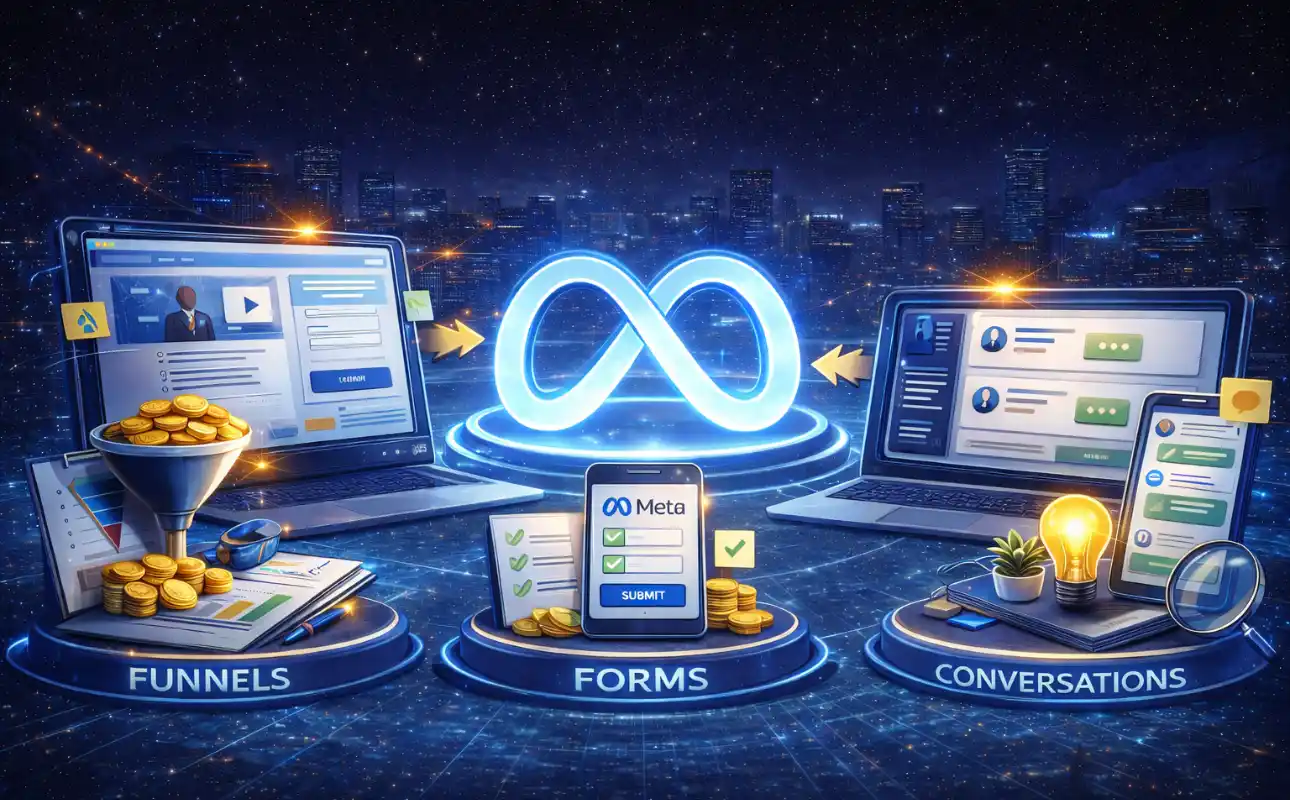
The Three Core Meta Ads Lead Systems
Almost every Meta campaign uses one of three systems.
Understanding their strengths and limits is critical.
Funnels: Landing Pages and Websites
Funnels send traffic to controlled environments.
They are best for:
- High-ticket services
- Education programs
- B2B offers
- Complex decisions
Strengths:
- Full message control
- Better qualification
- Advanced tracking
- Segmentation
Weaknesses:
- Higher friction
- Drop-offs
- Design dependency
Funnels reward clarity.
They punish vagueness.
Forms: Native Lead Ads
Forms remove friction.
They are best for:
- Local services
- Quick offers
- Entry-level products
Strengths:
- High volume
- Easy setup
- Low resistance
Weaknesses:
- Low intent
- Poor lead quality
- Weak commitment
Forms generate quantity.
They rarely generate readiness.
Conversations: Messenger and WhatsApp
Conversation-based systems prioritize human interaction.
They are best for:
- Consultative services
- Custom solutions
- Relationship-driven sales
Strengths:
- Context
- Personalization
- Trust building
Weaknesses:
- Hard to scale
- Operationally heavy
- Staff dependent
Conversations convert better.
They demand discipline.
Why More Leads Do Not Mean More Revenue
Many advertisers chase volume.
They want:
More forms.
More messages.
More calls.
What they get:
More noise.
More unqualified prospects.
More wasted time.
Low-quality leads:
- Drain sales teams
- Reduce morale
- Distort metrics
- Increase churn
Strong systems optimize for fit, not volume.
One good lead is worth more than ten weak ones.
Matching Your Meta Ads Lead System to Business Reality
There is no universal best system.
There is only alignment.
Here’s a practical guide:
High ticket + Long cycle
→ Funnels + Calls
Low ticket + Fast cycle
→ Forms
Custom services
→ Conversations
Recurring services
→ Hybrid systems
When the system fits the business, performance stabilizes.
When it doesn’t, everything feels broken.
The Follow-Up System That Determines Conversion
This is where most money is lost.
Not in targeting.
Not in creatives.
In response time.
Common problems:
- Leads called after hours
- No scripts
- No automation
- No accountability
- No tracking
Research and field experience agree on one thing:
The first 15 minutes matter more than almost everything else.
Speed builds trust.
Silence kills interest.
Designing a Complete Lead Journey
Buyers don’t move in straight lines.
They:
Visit your site
Read your posts
Compare options
Ask friends
Disappear
Return later
Your system must support this behavior.
That means:
- Retargeting
- Nurture content
- Remarketing
- Follow-up sequences
- Relationship building
A single form is not a journey.
It’s a checkpoint.
When Funnels Work Better Than Conversations (& Vice Versa)
Different businesses need different architectures.
A consultant may outperform with DMs.
A clinic may need structured funnels.
An agency may require hybrid models.
Templates fail because contexts differ.
Systems work because they adapt.
A reliable meta ads lead system transforms advertising from a cost center into a growth engine.
Traffic Is Easy. Conversion Is Mastery.
Buying traffic is simple.
Building trust is hard.
Meta Ads reward businesses that respect how people decide, not how dashboards look.
If your leads are not converting, don’t blame the platform.
Study your system.
Fix the journey.
Then scale.
In the next article, we’ll examine how to scale Meta Ads without burning cash, teams, or momentum.
Because growth without control is just delayed failure.