Modern marketers face a paradox: leads expect personal attention, yet managing that at scale seems impossible. That’s where AI lead nurturing transforms everything.
AI lead nurturing allows businesses to create human-like, data-driven relationships across thousands of prospects without manual effort. From predictive scoring to automated workflows, AI helps you deliver the right message, at the right moment, to the right person.
“Automation amplifies the human touch.”
In this guide, we’ll explore how AI and automation elevate lead nurturing from reactive to predictive and how you can implement it strategically to scale results without losing authenticity.
Why Scale Matters in Lead Nurturing
Traditional nurturing relies on manual follow-ups, email lists, and static workflows. It works until your leads grow faster than your bandwidth.
AI lead nurturing solves that scalability problem. By integrating intelligent automation into your marketing ecosystem, you can:
- Respond instantly to behavior signals
- Deliver hyper-personalized messages at scale
- Reduce friction between marketing and sales
- Predict which leads are ready to buy
When scaled properly, nurturing becomes less about managing leads and more about understanding them.
What Is AI Lead Nurturing
At its core, AI lead nurturing combines artificial intelligence with marketing automation to predict behavior, segment audiences dynamically, and deliver adaptive experiences. It doesn’t just automate, it learns. Every interaction trains the system to make smarter decisions.
Think of it as a self-optimizing loop:
- AI observes user behavior
- Predicts intent and readiness
- Triggers relevant actions automatically
- Analyzes outcomes to refine future messages
The result? A nurturing engine that grows more effective over time — powered by data, guided by empathy.
The Core Components of AI-Driven Nurturing
1. Predictive Lead Scoring
Forget static point systems. AI lead nurturing uses behavioral data like page visits, time on site, and email engagement to score leads automatically.
Example:
- A lead visits your pricing page twice → Score increases automatically.
- Another lead opens 3 emails but doesn’t click → Score drops slightly.
This real-time scoring helps prioritize high-intent leads while keeping others in nurturing sequences.
“AI turns gut feeling into data-backed precision.”
2. Dynamic Segmentation
Instead of manually assigning lists, AI segments leads continuously based on engagement, interests, and demographics. For instance, if a user shifts interest from “branding” to “automation,” your CRM updates their nurture sequence automatically.
3. Behavioral Triggers
AI detects subtle signals like link clicks, dwell time, repeat visits, and reacts instantly.
Examples:
- A blog reader downloads a guide → trigger educational email.
- A lead abandons a form → trigger retargeting ad.
- A client browses pricing → notify sales for follow-up.
Behavioral triggers create real-time nurturing flows that adapt to human behavior.
4. Content Personalization
AI systems like HubSpot’s Smart Content or GHL’s Custom Values dynamically change content blocks based on audience data.
Example: A software company might display different CTAs for startups vs enterprises in the same email.
This makes AI lead nurturing feel personal, even when automated.
How Automation Powers Scalable Nurturing
Automation is the muscle behind AI’s intelligence. It executes instantly, without fatigue.
Key Automations to Implement
- Welcome Workflows: Triggered when leads subscribe or download.
- Lead Progression: Move leads between lifecycle stages automatically.
- Re-Engagement: Detect and target inactive leads with tailored offers.
- Sales Notifications: Alert your team when leads hit a scoring threshold.
These automations ensure no lead slips through the cracks, and every message lands when it matters most.
“Automation brings consistency; AI brings context.”
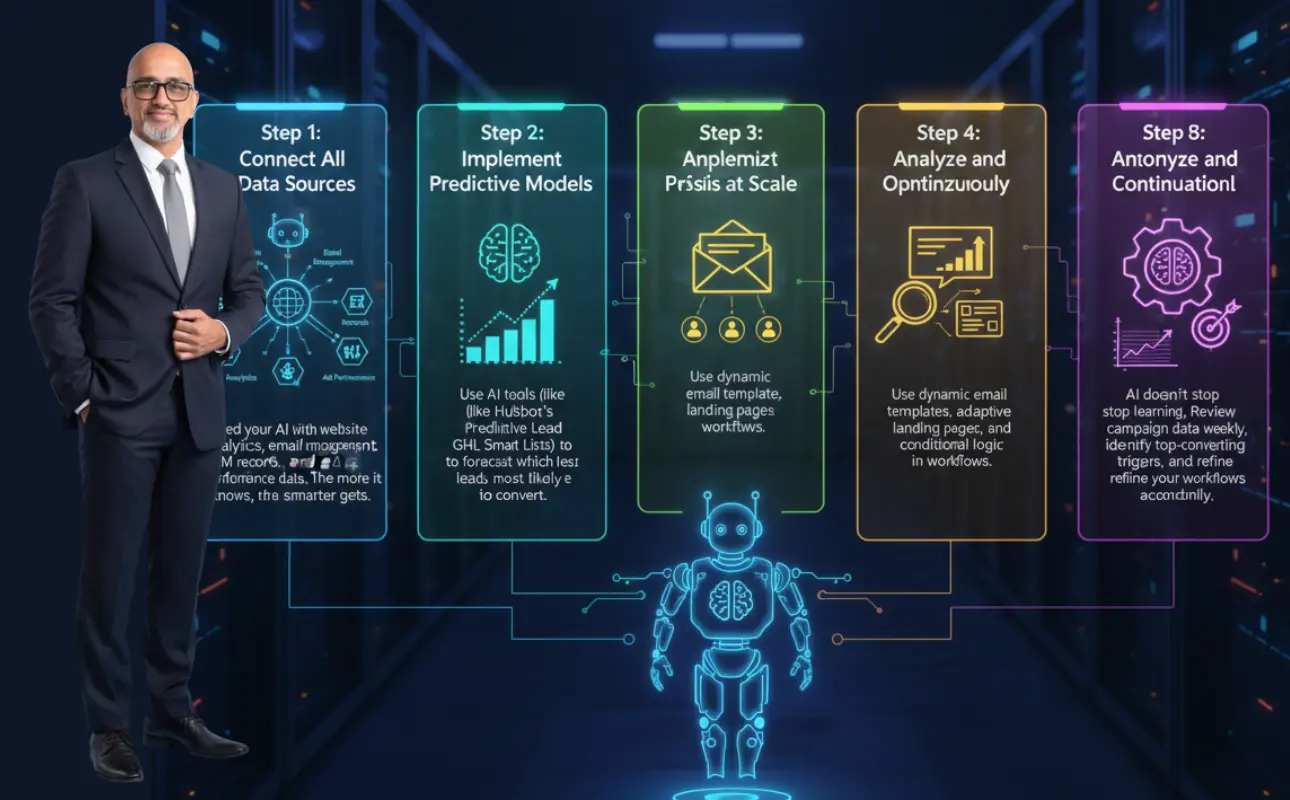
Integrating AI Into Your Existing Nurturing Systems
If you’re already using tools like GoHighLevel, ActiveCampaign, or HubSpot, you’re halfway there. The next step is adding intelligence to automation.
Step 1: Connect All Data Sources
Feed your AI with website analytics, email engagement, CRM records, and ad performance data. The more it knows, the smarter it gets.
Step 2: Implement Predictive Models
Use AI tools (like HubSpot’s Predictive Lead Scoring or GHL Smart Lists) to forecast which leads are most likely to convert.
Step 3: Personalize at Scale
Use dynamic email templates, adaptive landing pages, and conditional logic in workflows.
Step 4: Analyze and Optimize Continuously
AI doesn’t stop learning. Review campaign data weekly, identify top-converting triggers, and refine your workflows accordingly.
Emotional Intelligence Meets Artificial Intelligence
The best AI lead nurturing strategies combine machine logic with human empathy.
AI can detect what someone does but it’s human marketers who must interpret why.
To create emotionally intelligent nurturing:
- Pair behavioral triggers with emotionally resonant content.
- Use AI-driven insights to time outreach around buyer sentiment.
- Avoid robotic tone and use conversational copy in automation.
“The best AI doesn’t just analyze behavior but it also anticipates emotion.”
Real-World Applications of AI Lead Nurturing
Here are three examples of how brands are using AI to power their nurturing systems:
- E-commerce: AI sends predictive reminders based on browsing history, “You might like this” recommendations.
- SaaS: Predictive scoring identifies which free-trial users are most likely to upgrade, triggering targeted onboarding flows.
- B2B Services: Chatbots qualify inbound leads instantly, then sync data to CRM for sales follow-up.
Each example proves how AI lead nurturing helps marketers deliver precision at scale.
Common Mistakes to Avoid in AI-Driven Nurturing
- Over-Automation: When everything feels mechanical, trust declines.
- Ignoring Data Hygiene: Bad input data = bad AI decisions.
- Neglecting Human Oversight: AI needs supervision to review workflows regularly.
- Personalization Overload: Too much detail can feel intrusive.
Balance automation with authenticity. Always prioritize the customer’s comfort and privacy.
Measuring AI Lead Nurturing Success
Success in AI lead nurturing is about smarter interactions and not just sending more messages.
Track these metrics to measure effectiveness:
- Engagement Score: Weighted mix of clicks, opens, and time on site.
- Lead Conversion Rate: How many nurtured leads convert to opportunities.
- Response Time Reduction: How much faster your system reacts.
- Predictive Accuracy: How often AI forecasts match real outcomes.
- ROI on Automation: Time and cost savings from reduced manual effort.
Use GA4 event tracking and CRM dashboards to visualize these KPIs in real time.
The Future of AI Lead Nurturing
The future goes from automation to anticipatory marketing.
What’s Next:
- Conversational AI Assistants that nurture leads via chat in real time.
- Voice-Aware Campaigns that adapt tone based on sentiment.
- Predictive Retention Models that identify at-risk customers.
- Cross-Platform Orchestration where AI manages entire journeys autonomously.
Soon, AI lead nurturing will blend personalization, timing, and emotional context so naturally that every message feels handcrafted.
“AI will make nurturing invisible because it will simply feel like understanding.”
Bringing It All Together
Scaling doesn’t mean losing connection, it means amplifying it intelligently.
With AI lead nurturing, you combine automation’s efficiency with empathy’s authenticity.
The result? Personalized experiences that feel human, delivered at machine speed.
“In the age of AI, the brands that win are those that remember data serves emotion, not the other way around.”